




By: Ryan Kwatra
Delhi’s air crisis is truly unprecedented. Annual PM₂.₅ levels hover around 100 µg/m³ – nearly 25x
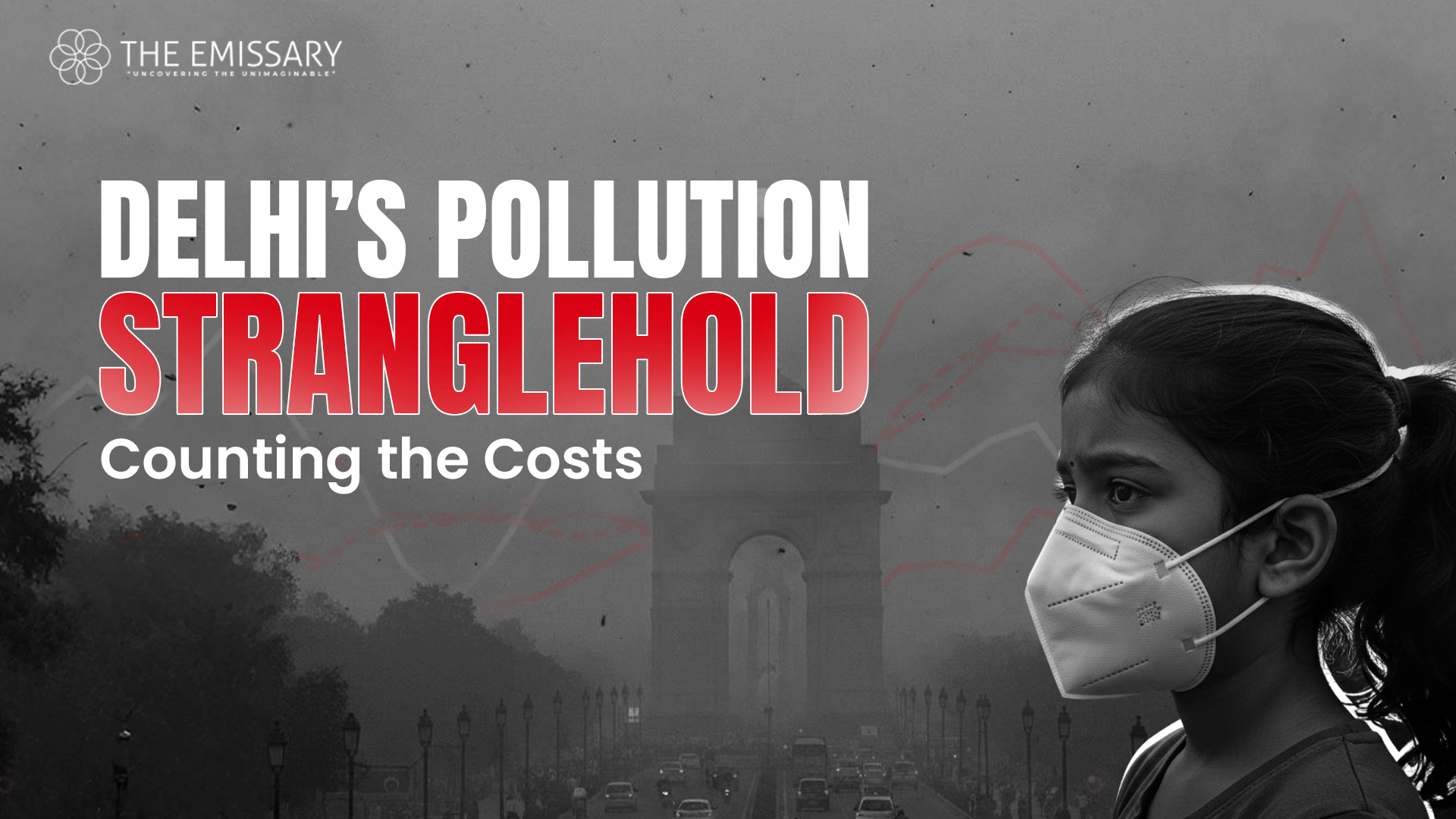
India’s own safe standard and 20× the WHO guideline. Delhi’s PM₂.₅ averaged 99.7 µg/m³ in 2022, and winter smog routinely pushes hourly levels into the 500-600 µg/m³ range. In mid-November 2024, Delhi even overtook Lahore to gain the ignominious title of“ the world’s most polluted city” with an AQI in the ‘severe ’zone (AQI ≈ 418). These levels, often described as “toxic mix of smoke and fog” in Delhi’s valleys, manifest in day-long “Very Poor” air for most of the cold season. A recent survey found Delhiites on average lose 8.2 years of life expectancy to fine‐particle pollution; one of the highest globally
Delhi’s smog reflects a multi-source problem. Local vehicular traffic alone accounts for 50–52% of PM₂.₅ emissions. Delhi’s road network is choked with 7.9 million vehicles as of 2023, two-thirds of them two-wheelers. Construction dust, unregulated industries and open waste burning add another 20-30% of particulates. Seasonal farm fires in Punjab, Haryana and UP inject a regional plume into the capital’s airshed, especially October-November, but their share has fallen, new analyses show stubble-burning contributed under 1% of Delhi’s PM₂.₅ in Oct 2024. Meteorology compounds the crisis as humid winter air and cold temperatures trap pollutants near the ground, while stalled ventilation means smoke, dust and vehicle exhaust accumulate for weeks. Delhi also draws pollution from neighbouring cities and power plants in the Indo-Gangetic Plain, underscoring the need for an “airshed” strategy across states.
Despite these diverse sources, policies have often focused on the wrong targets or been too weak to matter. Ad-hoc fixes such as closing schools, halting outdoor work, odd-even car rationing, have provided only marginal respite. In fact, an IIT-led study concluded that Delhi’s much-publicised 2016 odd-even traffic rule “failed to mitigate” particulate pollution, reducing PM₂.₅ only 2-3% in most zones, up to 8–10% in a few pockets. Long-term reforms have similarly stalled. A Supreme Court appointed commission (CAQM) once ordered a ban on diesel cars over 10 years old and petrol cars over 15 years, but political pushback forced the Delhi government to seek a stay . Other proposals including higher taxes on private cars, congestion pricing, and second-car levies that have been shelved amid “middle-class” outcry. In effect, Delhi’s officials have mostly implemented emergency measures rather than systemic change
The Economic Toll
“Choking growth” has become literal. Pollution is now a significant brake on Delhi’s economy. A detailed case study finds New Delhi lost about 6% of its GDP (US$ 5.6 billion) in 2019 due to air pollution, double the 3% of GDP lost nationally. Approximately half of that local impact came from health losses, the study attributes $2.8 billion to 11,310 premature deaths and $2.8 billion to 12.2 million lost work-days from illness. In practical terms, pollution costs mount through absenteeism, lower productivity and higher healthcare spending. The World Bank estimates that across India in 2019, air-related sick leave and fatalities cut $36.8 billion or 1.36% of GDP in India .
In Delhi, restricted business activity compounds these costs. During acute smog in winter, driving curbs, construction shutdowns and cancelled events sharply dent commerce as traders report a 20% fall in foot traffic during ‘severe ’pollution periods. One analysis found a 40% drop in online hotel bookings in Delhi in November 2019 when PM₂.₅ doubled, reflecting cratering tourism interest.More broadly, studies show that nationwide consumer spending could be $22 billion higher if air were clean, implying similarly higher retail activity in Delhi’s markets and malls. Vital festivals and wedding seasons are routinely blunted by smog; retailers report steep losses when sales peak coincide with emergency restrictions.
Businesses also face hidden costs. Flight delays and cancellations are frequent while supply-chain snarls such as diesel truck entry bans disrupt deliveries. A polluted environment even erodes Delhi’s competitive standing, in one global index Delhi fell 30 places in a year, largely because of its dismal air-quality score. Not surprisingly, a survey of 17,000 residents found 40% would rather leave Delhi than breathe its toxic air.
Delhi’s smog acts like a tax on the economy, suppressing growth, investment and commerce. One WEF/Dalberg analysis suggests that if Delhi could achieve safe air, its GDP could rise by roughly 6%. Whether through lost output or lost opportunity, pollution is a sizeable drag on the capital’s fortunes.
Lives and Livelihoods:
The human toll is harrowing. Delhi is among the most dangerous places to live. Estimates attribute tens of thousands of premature deaths in the city each year to polluted air. A 2020 study by IQAir/Greenpeace estimated 54,000 early deaths in Delhi that year, more than any other global city, from chronic diseases linked to PM₂.₅. Nationwide, 1.67 million lives were lost to ambient air pollution in 2019, roughly 18% of all deaths. New EPIC Chicago data underscore how this cuts life expectancy, the average Delhi resident effectively loses 8.2 years of life to the city’s PM₂.₅ vs 3.5 years for the typical Indian. At WHO’s recommended limit, those life-years could be regained.
These statistics translate into a landscape of illness and suffering. Children here suffer higher rates of asthma and developmental issues; heart attacks, strokes and cancers strike at younger ages. Hospitals see spikes in respiratory cases every winter. Public health surveys in Delhi cite eye irritation, cough and headaches as near-universal complaints during smog. Those with lung or heart disease or the elderly face acute crises and local doctors report many patients requiring oxygen on bad-air days. The burden falls disproportionately on the poor and vulnerable. Low-income families often live nearer busy roads or in unregulated areas, have less access to clean cooking fuel and healthcare, and suffer more from pollution both indoors and out. Education is also severely affected, Delhi has recorded hundreds of school closures over the last decade due to air warnings, forcing students to stay home, and millions of class-hours lost to gas masks and cancellations.
Beyond health, pollution damages social welfare. It erodes quality of life and community morale. Delhiites routinely avoid outdoor exercise and public events when the AQI spikes; masks on children at playgrounds have become normal. Domestic disputes rise and public anxiety percolates when poor air coincides with cold weather. Civic unrest even occur as elderly citizen protests and mothers ’advocacy groups such as “Warrior Moms” spring up demanding cleaner air for children. Such social strains, though hard to measure, subtly undercut labor productivity and can discourage skilled workers or companies from relocating to Delhi. On every street, Delhi’s smog exacts a personal cost be it in form of burning eyes, limited free movement, and a chronic background fear for health; a human toll not captured in balance sheets.
Where Policy Fell Short
Delhi’s pollution crisis grew from both policy gaps and behavioural choices. Historically, successes have been uneven. On the one hand, Delhi achieved notable gains in the past; the switch of public buses and auto-rickshaws to CNG by the early 2010s greatly cut exhaust particulates, and the 2017 shutdown of the last local coal power plant (Rajghat) eliminated a major city source. Yet many big culprits were not systematically addressed.
Despite clean-fuel drives, Delhi’s vehicle count has exploded. Many old diesel trucks, buses and autos still circulate, often poorly maintained. Though India has rolled out Bharat Stage VI (BS-VI) emission standards (akin to Euro VI) since 2020, enforcement is uneven with studies revealing real-world BS-VI pollution exceeds lab tests by multiples. Recent attempts to claw back high-emitting vehicles have faltered. In July 2024, pollution authorities ordered petrol cars over 15 years and diesel cars over 10 years off Delhi roads, but that move was stayed in court amid political opposition. Meanwhile, taxes on car ownership remain low; one analysis found Delhi’s public buses paid 5× more vehicle tax per passenger than private car owners. Attempts to raise parking fees or impose congestion charges foundered as well, city councillors rejected doubling fees on ‘middle class ’drivers. Such policy hesitancy has left private cars and burgeoning two-wheelers as the default mode, diluting gains from cleaner public fleets.
Authorities have tackled pollutants one piece at a time rather than holistically. Compliance orders often target only industrial plants registered in Delhi, ignoring factories just over the border. The National Clean Air Programme (NCAP), launched in 2019, promised a 20-30% PM reduction by 2024 in 132 non-attainment cities, but enforcement and funding have been weak. Many NCAP measures such as municipal waste bans, brick-kiln upgrades, and road sweeping remain under-resourced. Delhi’s city government and neighbouring states like UP, Haryana and Punjab have sometimes squabbled over who is responsible for winter fires or highway dust, rather than coordinating. The results are patchy interventions without ensuring compliance. For instance, open garbage dumps are banned, but enforcement is sporadic; many drains still channel untreated sewage to the Yamuna. The institutional response has often lacked “teeth” and an area-wide perspective.
More often than not, Delhi resorts to short-term emergency measures when pollution hits crisis levels. The year 2024 alone saw multiple rounds of graded response action plan (GRAP) stages: schools shut, construction halted, and truck bans imposed. These are necessary when AQI tops 400, but they don’t solve the underlying pollution load. As CSE experts note, stopping construction or odd-even driving can only “prevent loading of more pollutants,” they cannot clear existing particulate build-up. Thus Delhi remains locked in a cycle of emergency fixes, rather than adopting preventive planning.
Extending and Scaling Solutions
Delhi now deploys satellite-based monitoring (SAFAR) and a dense sensor network, improving forecast accuracy. Emissions standards have tightened nationally (BS-VI), and Delhi is rolling out thousands of CNG and electric buses. In 2023 the city’s electric-bus fleet stood at 3,400, with plans to expand to 7,000-8,000 by 2026 . The Delhi Metro is steadily expanding, now over 470 km, though ridership dips imply more needs to be done on last-mile connectivity. Efforts like distribution of LPG under the Ujjwala scheme and promotion of solar home systems have cut indoor biomass use, indirectly improving ambient air.
The Commission for Air Quality Management (CAQM) in 2022 began enforcing stricter rules for the first time region-wide, including the banning of all BS-III (Euro-III) trucks from Delhi NCR after 1 November 2025. These fuel transitions are crucial as over the last decade, diesel use in Delhi, for generators and vehicles has plunged by two-thirds , thanks to bans on diesel generators and industries. Another new tool is performance-based funding, the 15th Finance Commission allocated $1.7 billion for air-quality improvement (FY2020–25) to cities that achieve pollution-reduction targets. Such incentives, if unlocked by meeting annual goals, could help scale measures like cleaner buses, dust control machines and affordable EV charging.
Delhi’s EV policy, adopted in 2020, aimed for 25% of new vehicle sales to be electric by 2024. Progress has been slower, EVs were only about 15% of new registrations by 2025, but the commitment is there. To push further, Delhi is considering mandates for automakers and phasing out conventional-ICE vehicle sales, as hinted by draft policies. Expanding EV charging infrastructure in public spaces and housing colonies is also on the agenda. Private-industry partnerships including with with EV startups and continued subsidies for bikes and autos can help, as long as the political backing holds; recent withdrawal of EV purchase subsidies did cause a setback.
On the ground, Delhi has embraced more green cover and urban-cleanliness drives. Street sweeping and road-washing are standard during high-pollution alerts. City planners are testing “green corridors,” dedicated lanes for e-buses and bicycle tracks, to reduce reliance on cars. A 2025 plan to revive the Yamuna by updating old sewage-treatment plants signals a shift toward integrating water, waste and air policies. Experts note that treating Delhi’s pollution as a multi-sector “airshed” problem could yield far more sustainable gains.
Future steps are clear, mass transit must be further strengthened, fuel quality enforced without loopholes, and cross-border pollution tackled by working with neighbouring states on crop residue management. Authorities must pivot from crisis-fighting to prevention such as enforcing vehicle scrappage, industrial norms, and waste segregation. Enhanced urban forestry can also help filter particulates. Crucially, the NCAP targets have now been raised to a 40% PM₂.₅ cut by 2026, reflecting recognition that the initial goals were insufficient. Achieving this will require robust monitoring and real penalties for violators.
International models show it’s possible. Beijing’s stringent fuel-switching and driving restrictions have eventually brought that city’s worst pollution episodes down to Delhi-like levels. Delhi can learn from such successes, using data-driven policies, the clean air apps and accountability dashboards launched in 2025, to track progress in real time.
Beyond the Smog:
While air is the headline issue, Delhi battles other pollution forms that compound its woes. Its rivers and streets tell a similar story of strain. The Yamuna River passing through Delhi is heavily contaminated. Though only about 2% of the river’s length lies in Delhi, studies find this 22 km stretch carries 79% of the Yamuna’s total pollution load. In practice this means the river often runs foamy and high in toxins by the city. Raw sewage and industrial effluent pouring into Yamuna degrade the city’s drinking-water source and ecology as recent tests at the Wazirabad intake detected ammonia levels far above safe limits. This riverine pollution, besides devastating aquatic life, raises Delhi’s public health risk by encouraging mosquito breeding and bacterial spread.
On land, solid waste is another crisis. Delhi generates over 10,000 tonnes of garbage each day, of which perhaps two-thirds is collected for disposal. The rest ends up in illegal dumps or is burnt in fields and open pits, sending yet more particulate and toxic emissions skyward. Open waste burning is officially banned, but enforcement is uneven. E-waste and industrial waste add to groundwater contamination in parts of the city. Noise pollution from heavy traffic, construction, and loudspeaker usage, is perennially high; intersecting with air pollution to worsen stress and cardiovascular risk.
All these factors reinforce the drag on Delhi. Polluted water and streets deter tourism and investment just as much as hazy skies do. In neighbourhoods adjacent to waste dumps or open sewage drains, property values are depressed and respiratory illness rates higher. Delhi’s branding as a “global city” suffers: few foreign visitors want to see India’s capital only through a toxic veil.
The High Cost of Inaction
Delhi’s pollution is not an externality, it is a full-blown development bottleneck. The data are stark, the World Economic Forum-backed analysis we cite shows roughly half of Delhi’s air-pollution impact comes from lost life and health; the remainder from economic disruptions and reduced productivity. Billions of dollars of growth, and thousands of healthy life-years, slip away each year because of contaminated air. As one policy review put it, these losses “threaten to undermine Delhi’s critical competitive advantages”.
Yet the picture is not hopeless. Removing pollution could unleash stalled potential. Cleaner air would immediately boost labor productivity and health, one study estimates Delhi’s smog cuts its GDP by about 6%, implying an equivalent gain upon cleaning the air. It would revitalise tourism, improving visibility at monuments and air qualities at hotels, ease healthcare expenditures, and allow children to play outside again.
Delhi must combine aggressive local action such as vehicle bans, transit, industry control with a regional framework which includes cooperating with Punjab and UP on crop residue, and Haryana on power emissions. It must also build social consensus that these measures are urgently necessary. Allocating adequate funding such as fully utilising the $1.7 billion clean-air fund will be key, as will transparent monitoring of results. If Delhi can extend its current mitigation efforts, with visible success across EV shift, Metro, and waste treatment, to true scale, it can break the vicious cycle of smog.
Ultimately, the stakes are profound. Pollution in India’s capital isn’t just an environmental problem, it’s an economic and humanitarian crisis. The longer comprehensive fixes are delayed, the more Delhi will pay in drained productivity and in human suffering. As one report warns, continuing on
the current path could cause Delhi to “lose ground” both within India and on the world stage. The city may be India’s seat of power, but without clean air it cannot claim full prosperity or even the health of its people. The costs of inaction, already measured in lives and livelihoods, are simply too high to bear.