




By: Gayatri Chitralekhaji
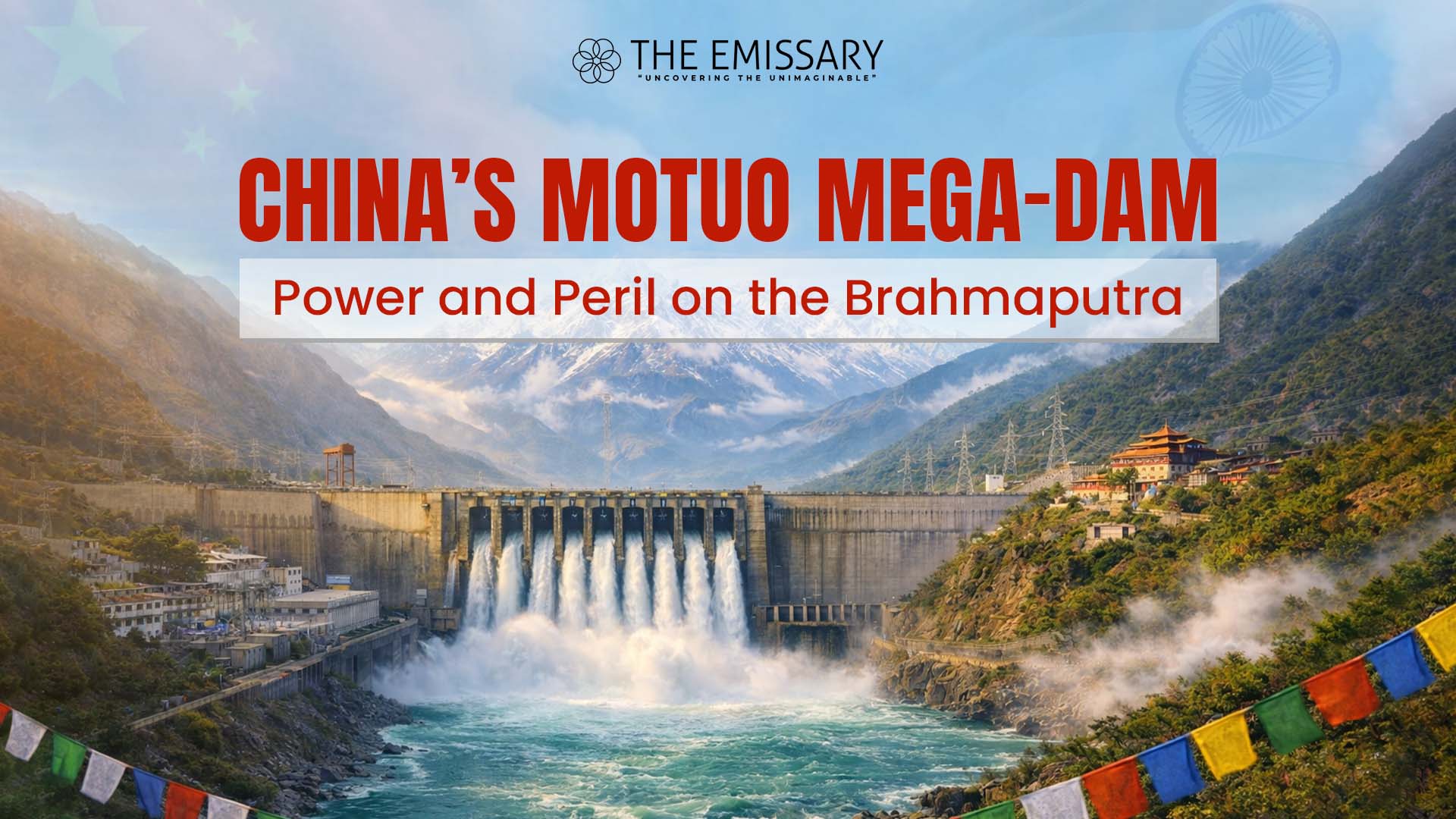
China has launched construction of an unprecedented hydropower project on the Yarlung Tsangpo, also known as the Brahmaputra, River in Tibet’s Motuo (Medog) county. Billed as the world’s largest hydroelectric scheme, the “Motuo” or Yarlung Tsangpo Hydropower Station will consist of a cascade of five dams and underground powerhouses harnessing a dramatic 2,000-metre elevation drop in the river’s Great Bend. Officials say it will generate roughly 300 billion kilowatt-hours per year, about three times the output of the Three Gorges Dam, with a total installed capacity of some 60,000 MW (60 GW). At an estimated cost of about 1.2 trillion yuan, US$160-170 billion, the project dwarfs any previous dam. Its scale would far exceed even the famed Three Gorges Dam of 22.5 GW capacity and the Itaipu Dam of 14 GW, making it, the planet’s most ambitious hydropower scheme. By some estimates the new dam’s generation alone would supply roughly the annual electricity consumption of Britain or power some 300 million homes. The Chinese state media call it a “project of the century” and say it will help meet Tibet’s power needs and China’s renewable-energy targets.
The Motuo scheme will be built in stages. Four 20-km tunnels will divert water through the Namcha Barwa Massif to five underground stations arrayed along 50 km of canyon. Chinese engineering teams describe it as a run-of-river cascade with comparatively little storage, exploiting the river’s steep drop without a massive reservoir. Still, it poses colossal engineering challenges, the site lies in a narrow, landslide-prone canyon above a tectonic fault line. State run Xinhua news service says Chinese Premier Li Qiang attended the July 19, 2025 groundbreaking ceremony and stressed “ecological conservation” even as work begins. State-owned China Yajiang Group will oversee construction, which is slated for completion in the early 2030s, premier Li indicated operations by the mid-2030s.
The scale of Motuo is almost unfathomable. By energy output it would triple Three Gorges, and far exceed South America’s Itaipu plant. Three Gorges itself has the world’s highest capacity 22.5 GW, producing on the order of 100-110 TWh/year. By comparison, Motuo’s planned 300 TWh/yr generation would make it the single largest generating source on the planet. By installed capacity, Motuo’s 60 GW would be nearly three times Three Gorges and dwarf all existing dams. The project’s sheer ambition and cost mark a dramatic push to exploit Tibet’s water resources.
Project Status and Timeline
After years of secrecy, China officially confirmed the dam in late 2024 and broke ground on July 19, 2025. Premier Li Qiang, flanked by officials, announced that “construction has begun on what will be the world’s largest hydropower dam”. Xinhua reports place the dam site at Gelling in Medog, only 30 km from the contested India–China frontier. The scale is enormous, five separate powerhouses, five dams in cascade, four high-capacity tunnels through the Namcha Barwa massif. The river drops roughly 2,000 metres over a 50-km stretch here, yielding tremendous hydropower potential.
Chinese engineers say they will press ahead quickly. State sources project operations by around 2033. In official replies to India’s parliament, Beijing confirms Motuo will be built in one phase, with five stations totalling 60 GW to be completed by the early 2030s. India’s External Affairs Ministry notes it “carefully monitors” the project, warning it will “take necessary measures to protect our interests” as needed. For now, all evidence points to an active construction campaign in Tibet; satellite imagery already showed tunnelling at Namcha Barwa before the ground-breaking ceremony.
India’s Water Security and Strategic Concerns
India’s government and security analysts have reacted with deep alarm to Motuo’s scale and proximity. The Yarlung Tsangpo, upon entering India, becomes the Brahmaputra, a lifeline for Assam and Arunachal Pradesh, before feeding Bangladesh. Delhi’s main fear is the potential to “weaponise” that water. Indian officials note that China’s project sits barely miles above the international border, in a disputed sector of Arunachal Pradesh, so control over the river at source would give Beijing unprecedented leverage downstream. A formal Indian analysis concluded that the Motuo dam could, in a worst case, cut up to 85% of the Brahmaputra’s flow during the dry season. That prospect has spurred India to fast-track plans for its own storage dam on the Upper Brahmaputra in Arunachal Pradesh.
Local Indian media cite officials saying only about 30-35% of the Brahmaputra’s annual flow originates in Tibet, with the remaining 65-70% fed by the monsoon rains in India. Still, even if most volume comes from rain, China’s dams could severely modulate timing and quantity, especially in lean winter months. In January 2025 Assam’s Chief Minister Himanta Biswa Sarma stressed that the Brahmaputra is largely “rain-fed” in India, but he warned that a deliberate upstream cutoff could spell disaster for farmers and power generation in the northeast. Beijing dismisses such fears, insisting a run-of-river scheme will not hurt downstream supply, but experts caution that any reservoir or gating structure automatically confers the ability to throttle flows or suddenly surge water.
In the northeast’s crowded Brahmaputra basin, where nearly 130 million Indians depend on its flow, anxiety is high. Local tribespeople have been protesting India’s counter-dam, thousands of Arunachalis gathered in early 2025 to denounce the 11 GW Upper Brahamaputra project as a threat to their villages. Arunachal’s Chief Minister Pema Khandu, has insisted that India’s dam is “not just a hydro dam… its real objective is to save the River… from China”. Analysts further note that while the Chinese dam would be in India’s nominal “far upstream”, it coincides with disputed territories, China’s claim line in Arunachal, raising nationalist passions on both sides. India’s intelligence and military planners reportedly worry not just about water flows but also about new Chinese infrastructure and garrisons in the Medog area accompanying the dam. Many Indian experts see Motuo as part of a broader strategy of Chinese dominance of Himalayan water and border regions.
Hydrologists also warn of severe ecological ramifications. India’s Brahmaputra supplies vital sediment that fertilises the floodplain. A recent scientific study cited in journalism literature notes that big dams can starve downstream soils of silt, degrading farmlands and deltas. Indian scientists fear Motuo will trap huge sediment loads and alter monsoon floods, worsening soil salinity and eroding fish stocks. Bangladesh relies on the Brahmaputra-Jamuna for 70% of its population’s livelihoods, so Dhaka has also pressed China for assurances, but Beijing has shared little more than generic statements about not disrupting flows.
Strategically, India’s political class frames any loss of Brahmaputra control as a national-security crisis. Defence analysts note the river is India’s fourth-longest, supplying irrigation, drinking water, and hydropower in Assam and Arunachal. In an August 2025 briefing, External Affairs Minister S. Jaishankar warned China “against weaponising the dam, whether to stop the flow or to cause a flood”. Security thinkers underscore the symbolism, this is a giant hydrological project on a transboundary frontier, coming amid a fragile military détente. Carnegie India analyst Shibani Mehta cautioned that Motuo “lays the groundwork for a contentious new chapter in a relationship already defined by mistrust, border clashes and competing regional ambitions”. Professor Srikanth Kondapalli of Jawaharlal Nehru University notes that without progress on border issues, even such infrastructure projects risk “becoming another flashpoint”.
Veteran strategist Brahma Chellaney goes further, calling the dam “a global threat” because it cements China’s control over one of Asia’s lifeblood rivers. Chellaney warns that Tibet’s rivers, often likened to Asia’s “water tower”, feed many neighbours, and that China “has built more large dams than the rest of the world combined” on international rivers. With no binding water-sharing treaty or U.N. convention to constrain it, Beijing can assert “indisputable sovereignty” over Tibetan waters. His conclusion, Motuo would give China a hydraulic chokehold on the Brahmaputra, akin to an oil producer’s grip on oil supply. In practical terms, China could in future throttle water for downstream users without firing a shot, or threaten to do so, just as India’s stranglehold on the Chenab over Pakistan once became a major crisis. Many Indian analysts see a worrying parallel and fear the Motuo dam could one day be used as a “water weapon” in any conflict, affecting tens of millions downstream.
International Law and Riparian Norms
Diplomatic and legal options are limited. Unlike the Indus basin, until recently governed by the 1960 Indo-Pak treaty, the Brahmaputra has never witnessed a basin-wide accord between China and its downstream neighbours. China and India have never signed a water-sharing treaty for the Brahmaputra. The only formal arrangement is a narrow 2002 Memorandum of Understanding, by this deal China committed to sharing hydrological data including water level, flow, and rainfall at three Tibetan monitoring stations twice daily during flood season (January-October), and to notify India of any abnormal floods outside that window. It contains no guarantee of flow volume or consultation on dam construction. Notably, China has on occasion halted even that limited data exchange during political tensions, as in 2017.
In this gap, India has repeatedly urged “transparency and consultation” on upstream works. New Delhi’s line is that as the lower riparian, it has “established user rights” under principles of international law, and China owes a duty not to harm downstream users. But in practice, China can point out that no binding treaty constrains its actions on the Tsangpo. A recent analysis observes that India’s protest has been “largely rhetorical and diplomatic, rather than legal, India could not point to a river-basin treaty that legally limits China’s usage of the Yarlung Tsangpo or prohibits the dam”. Absent a treaty, Beijing is not strictly breaching any international agreement by building Motuo, even if it violates the spirit of “no significant harm” and equitable use that underpin global watercourse norms. Both countries are also non‑parties to the 1997 U.N. Watercourses Convention, which enshrines equitable usage and no-harm principles, so there is no multilateral arbiter to enforce.
India has floated ideas of a Brahmaputra Commission or expanded data cooperation, but Beijing insists its projects are purely domestic infrastructure. Foreign Ministry statements repeatedly assert that China’s dams “have undergone rigorous scientific research” and will not adversely affect downstream ecology or water. In essence, New Delhi’s recourse has been diplomatic protest and multilateral pressure. The Indian government officially “urged” China to ensure downstream interests are not harmed, in public statements and at meetings such as the Shanghai Cooperation Organisation foreign ministers’ meeting. To date, China has offered little beyond vague assurances, and India continues to explore every avenue, from international law forums to closer ties with Bangladesh and other Brahmaputra states, to underscore the need for dialogue.
Enthusiasm and Concerns
The official tone is certainly upbeat. Science Minister Jitendra Singh said SHANTI is “aligned to achieve the objectives of increasing the share of nuclear energy” while still “honouring India’s obligations towards safety”. In Parliament, PM Modi and Minister Singh highlighted multi-year consultations with industry, scientists and even startups on the Bill. They stress that core safety controls such as regulator power, physical security, and spent-fuel custody remain government-held.
Foreign expert Robinder Sachdev, involved in past Indo-US nuclear accords, argues SHANTI was “long overdue”. He notes that the 2010 liability law had scared off Indian firms (BHEL, L&T) and foreign majors alike. By removing supplier liability, Sachdev says the Bill “creates the right environment for private operators and vendors”, unlocking stalled projects and ultimately delivering cheaper, cleaner power. “After this, nuclear energy will be cheaper than coal,” he tells ANI. He points out nuclear plants last 70-80 years versus 30-40 for coal, and emit zero carbon during operation. In his view, India’s 100 GW target by 2047 can finally be pursued in earnest now that domestic capital and global technology can be mobilised. Several industry voices share this optimism, financiers and equipment makers see a potential $200+ billion investment opportunity in civil nuclear.
Leading conglomerates and utilities will be watching closely. A Moneycontrol analysis lists Tata Power, Adani, JSW and others as likely entrants under SHANTI. Adani Group sources, have been in talks to install multiple 200 MW SMRs in Uttar Pradesh. Legal experts note that foreign companies such as Westinghouse, GE-Hitachi and EDF have long insisted on capped liability to sell reactors to India. Reports observes that SHANTI removes supplier risk and doubles operators’ caps to ₹30 billion for big reactors, measures designed to reassure both domestic and international investors. A partner at JSA Advocates explains that foreign participation is allowed but must be structured through Indian-incorporated entities.
Not all reactions are favorable. The opposition in Parliament uniformly called for a select committee review, lamenting the “bulldozing” of the Bill. MPs berated the dilution of liability and the lack of transparency by keeping the law out of RTI. One MP warned that the law “dismantles the liability framework established after the Bhopal tragedy”. Environmental and anti-nuclear activists echo such concerns, G. Sundarrajan of Greenpeace India told the Associated Press that SHANTI “takes away essential safeguards” and makes it “nearly impossible” for victims to seek redress. Opposition leaders accused the government of privatising profits while socialising risks, warning that the sensitive sector could fall prey to “crony capitalism” .
Some domestic critics also view the move in geopolitical terms. The Wire and other commentators highlight that U.S. and other suppliers had pressed India to relax liability norms for years. They note that the timing, amid ongoing trade talks, suggests India is making concessions to unlock Western investment. The SHANTI Bill language hints at this, its statement of objectives underscores innovation and clean energy, even as it quietly deletes the old supplier clause. Nevertheless, government and pro-reform experts counter that India’s own needs and self-interest,
not foreign pressure, drive the change.
Expert and Strategist Perspectives
Indian military planners and security scholars treat the Motuo project as a watershed for regional stability. They draw on historical analogies and technical assessments alike. One fear is seismic, Medog lies in one of the world’s most geologically unstable zones. Analysts recall that even China’s smaller dams have induced landslides and earthquakes; they warn a dam collapse or quaketriggered breach in Tibet could send a wall of water into India’s plains.
Others highlight hydrology. Indian specialists point out that even minor interruptions could wreak havoc in the dry season, since Eastern Himalayan rivers have high seasonality. The Indian government’s 2025 analysis predicts China could withhold roughly 40 billion cubic metres annually, or 1/3 of the Brahmaputra’s flow at the border, if it chose. This would imperil cities like Guwahati, farming in Assam, and massive Indian hydro projects downstream. Noted ecologist D.K. Yelery of the Jawaharlal Nehru University and others have warned that blocking sediment flow would lower soil fertility across the northeast floodplains. They emphasise that while the river is two‑thirds fed by Indian rain, China’s dams change the timing of that flow, not just its quantity.
At the strategic level, think-tank analysts argue that control of the Brahmaputra is inherently a security issue. The river flows through Arunachal Pradesh claimed by China as “Southern Tibet”, where Indian troops and infrastructure are stretched thin. An upstream dam gives Beijing not only technical leverage but also stronger tactical control of the border region. Some scholars draw parallels to China’s dams on the Mekong, which have been used to influence lower-riparian states’ policies. These analysts urge India to treat Motuo as an extension of broader China competition, a way to test India’s resolve and partnerships. As one Indian defense journal put it, “the dam’s strategic importance for India’s national security” is immense, requiring a firm response.
Inside India, opinion is mixed. Some experts caution against knee-jerk “water-war” rhetoric, noting that much of the Brahmaputra’s water would come anyway. Others say China’s track record with no sharing treaties, periodic cessation of data in crises justifies alarm. Regardless, few dispute that Motuo adds a dangerous new element to already fraught ties. As a South China Morning Post analysis put it, “this issue” big dams on the Brahmaputra “could become another flashpoint” unless both sides carefully manage it. Indian strategists now routinely warn that Beijing could, at least theoretically, hold India’s northeast “in Beijing’s hands” by throttling or flooding the river.
India’s Response: Dams, Diplomacy and Data
If successfully implemented, analysts believe SHANTI can unlock a nuclear energy renaissance in India. Proponents envision hundreds of reactors, both large and modular, being added in coming decades. The law Faced with Motuo, India’s response has been three-pronged: diplomatically urgent, militarily cautious, and technologically proactive.
New Delhi has lodged official protests and used every diplomatic channel to press Beijing on transparency. In Parliament and press briefings, India’s External Affairs Ministry has said it is “carefully monitoring” the project and has repeatedly urged China to share hydrological data and consult downstream countries. EAM Jaishankar personally raised the issue with China’s leadership during talks in mid-2025, and Indian spokesmen stress the doctrine that as a lower riparian India has “established user rights” on the river. In August 2025 the MEA officially reported to Parliament that the need for “cooperation on trans-border rivers, including resumption of…hydrological data” had been highlighted during the Shanghai Cooperation meeting. Indian officials have also briefed partners like Bangladesh, whose leaders have quietly pressed Beijing for information. At multilateral forums India has framed water security as a global concern, though China resists any outside scrutiny of Motuo.
Perhaps the most dramatic Indian countermeasure is its own dam-building program in Arunachal Pradesh. New Delhi is now expediting the proposed 11,000-14,000 MW Upper Siang Multipurpose Dam, with a storage of roughly 9-14 billion m³. This project, when completed, would be India’s largest dam, intended explicitly to buffer and moderate flows from upstream. In January 2025, Indian engineers and officials began site surveys near Parong in Arunachal. The government argues that a large Indian reservoir can release water in lean months to offset Chinese withholding, and hold back water to absorb any flood surges from Tibet. Arunachal’s BJP leadership has defended the Siang dam as “flood moderation” to “counter any potential water surges” from China. This “dam for a dam” strategy has its own costs and controversies, but Indian planners see it as a necessary insurance policy.
India also seeks to improve its information and forecasting capabilities. New Delhi has repeatedly urged Beijing to resume the 2002 data-sharing arrangement. With limited success, it has invested in satellite surveillance and independent modelling of the Brahmaputra’s flow. Defence analysts advise developing a real-time monitoring network using satellites and open-source data, so India will not be caught blind if upstream conditions change. There are plans to upgrade flood-warning systems and coordinate with Assam and Bangladesh on emergency release protocols. On the water-supply side, India is promoting water conservation and off-stream storage, and strengthening cooperation with downstream Bangladesh, which shares major wetlands and delta ecosystems. The idea is to diversify risk, if one project changes flows, dams and canals elsewhere can compensate.
In tandem, Indian strategists have sought to internationalise the issue. New Delhi highlights the project at conferences on climate and water security, framing Motuo as a challenge to agreed norms. While no treaty legally binds China on the Brahmaputra, India argues that customary principles, equitable use, prior notification, demand a cooperative approach. Government ministers have floated the notion of a formal Brahmaputra Commission, analogous to the Mekong River Commission, to bring China into dialogue. Environmental and Buddhist groups have petitioned world institutions for oversight, though these remain fringe efforts.
Whatever the strategy, experts say India cannot simply ignore the Motuo dam. It is investing in alternatives: hydropower on Indian tributaries, solar and wind to reduce reliance on imported electricity, and perhaps bilateral projects with Bhutan and Nepal to share water resources closer to home. Hence, India’s answer is to match China’s hydropower build-out with its own infrastructure, while pushing for transparency and building regional alliances.
Conclusion
China’s Motuo (Medog) hydropower project is unprecedented in ambition. At full scale it will generate far more electricity than any existing dam, and reshape the Brahmaputra’s hydrology. For India and other downstream states, the dam is both a promise of clean energy for China and a potential vulnerability for those below. Indian policy-makers, hydrologists and strategists now treat it as a multifaceted challenge, one of water security, regional influence and border dynamics. While China insists Motuo is benign and “run-of-river,” India fears it could become a potent tool or weapon in Beijing’s hands. With no binding treaty to govern shared flows, the only remedies are diplomatic engagement, counter-infrastructure and vigilant monitoring. As one analyst put it, Motuo may not spark immediate conflict, but it has “unleashed tensions” that could define South Asian diplomacy for years to come.