




By: Pallavi Raghavan
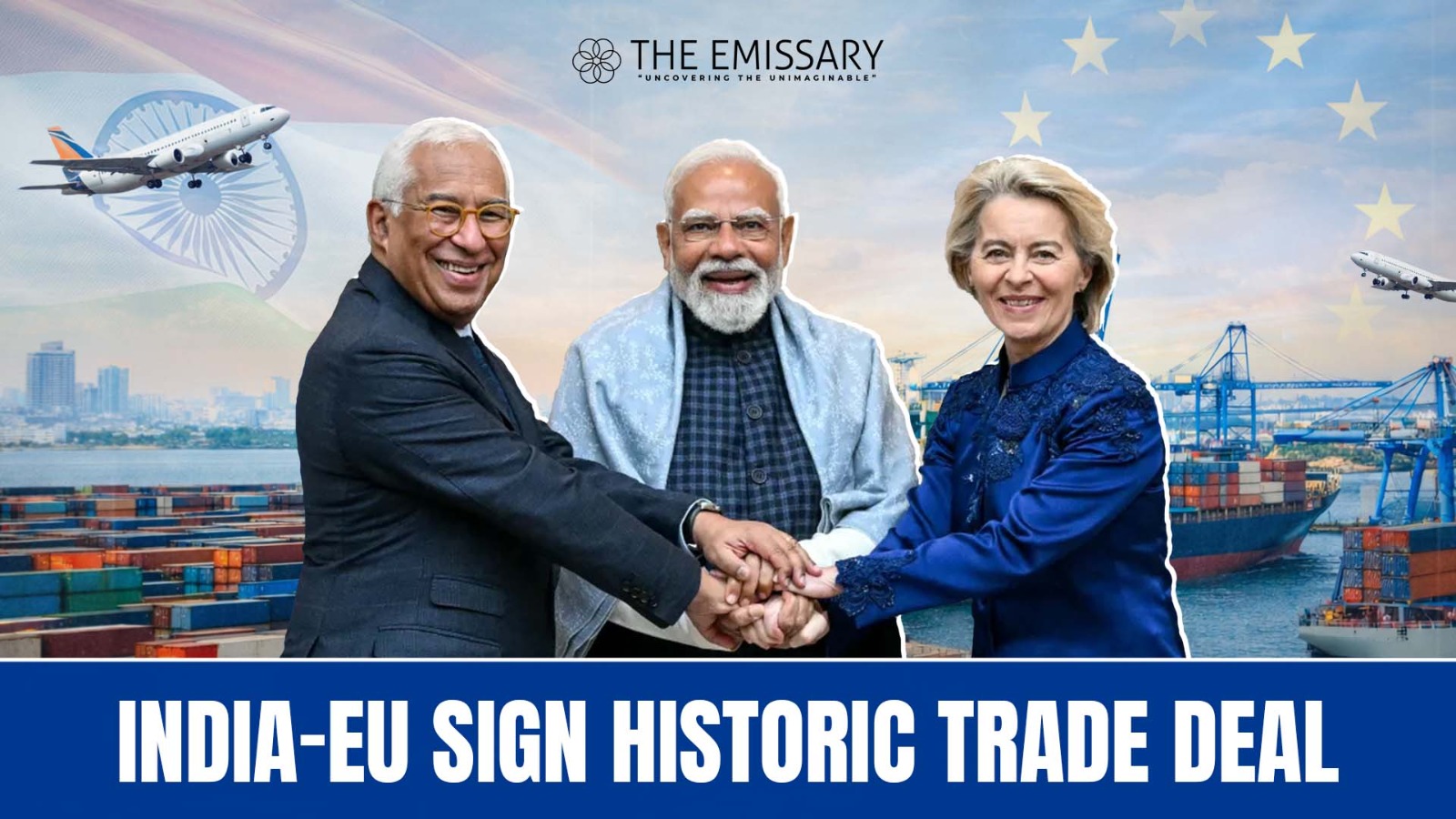
After nearly two decades of negotiations, India and the European Union are poised to seal a landmark free-trade agreement. The pact, often dubbed “the mother of all deals,” will link markets of roughly two billion people and about a quarter of the world’s GDP. Prime Minister Narendra Modi and EU leaders, including Commission President Ursula von der Leyen and Council President António Costa, plan to sign the deal at the India-EU summit in New Delhi on January 27, 2026. Brussels and New Delhi have touted the agreement as a major strategic victory. It comes as global trade is roiled by tariffs and geopolitics, offering a chance to deepen ties and diversify trade. India’s Commerce Secretary calls it “New Delhi’s largest agreement,” amid U.S. tariff pressures, and analysts say the deal will boost exports for both sides.
Sectoral Gains and Details
“The FTA is expected to significantly help Indian exporters of textiles, garments, leather goods, and other labour-intensive products. EU tariffs on many such Indian exports currently range from 2–12%, and up to 16% on some garments. Eliminating these duties will make Indian goods more competitive in Europe. Think-tanks predict that textiles, apparel, leather, and footwear exports will rise, as will Indian pharmaceuticals and chemicals through streamlined regulatory approvals. India’s services sector, such as IT, telecom, business services, and transport, is also set to gain greater EU access.
Europe’s major manufacturing firms are also likely to benefit. India currently imposes steep tariffs on imported cars—often 100% so cuts here would greatly expand EU car exports. Medical devices, machinery and high-tech equipment will similarly face fewer barriers. In return, India is pushing for duty-free access for its growing automotive sector, notably two- and three-wheelers, and faster market entry for its expanding electronics industry. Steel and metal products are sensitive; India’s exporters fear the EU’s new carbon border tax, which could be 20–35% on steel/aluminium, so Brussels is negotiating safeguards. Cuts on auto, machinery and chemicals are on the table, but terms on steel and environmental levies will need extra work.
Both sides have largely kept agriculture outside the agreement. India’s millions of farmers, roughly 44% of the workforce, remain protected. New Delhi has excluded staple crops, dairy and sugar from the talks. The EU, for its part, backed off demands on items like sugar and dairy to avoid political backlash. As a result, only a limited list of farm products will see new access, and many sensitive tariffs stay in place. In practice this means food and farm trade will change little, since both sides chose to shield their domestic agriculture while agreeing on gains elsewhere.
The FTA goes far beyond goods. It contains chapters on services, investment, intellectual property, and digital trade. India’s big IT and telecom services firms can expect smoother access to EU markets, while EU providers of legal, engineering and digital services gain clearer rules. The deal includes an ambitious Trade & Technology Council and investment-protection talks, aiming to spur cross-border capital flows. European Commission data show that about €140 billion of EU FDI is already in India, with around 6,000 EU firms operating there. The FTA should encourage even more European investment in Indian manufacturing, green energy, transport and digital infrastructure.
Advanced sectors on both sides stand to gain; pharmaceuticals, chemicals and specialized manufacturing will benefit from aligned regulations and faster approvals. Indian generics could enter Europe more easily under common standards. On the EU side, producers of industrial machinery, aerospace parts, chemicals, electronics and diamonds will have lower tariffs in India. Even luxury items like premium wines, spirits and autos, which now face duties up to 100–200% in India, will become more affordable. Notably, the pact explicitly promotes cooperation in renewable energy and clean technologies, which should accelerate joint projects on batteries, electric vehicles and waste-to-energy.
These sectoral shifts are significant given the scale of EU–India trade. In 2024 bilateral goods trade was about €120 billion, roughly evenly split between Indian exports of petroleum products, electronics, pharmaceuticals, textiles and EU exports of machinery, vehicles, medical devices, chemicals. When services are included, total two-way trade reached roughly €184 billion in 2023 alone. As the EU notes, “India’s success benefits the EU, just as the EU’s success benefits India.” The new agreement promises to lift these flows further; analysts forecast rising volumes as trade barriers fall. India’s status as a fast-growing $4–5 trillion economy, targeted to be the world’s third largest by 2030, and Europe’s technological edge mean that deeper integration could be transformative for both.”
Geopolitical Timing
The timing of the pact is deliberate. EU leaders have framed the deal as a response to a volatile geopolitical landscape. At Davos earlier this month, von der Leyen underscored that Europe and India together now represent about 25% of global GDP. The agreement thus forges a massive protrade bloc at a time when “trade is the new geopolitics”. Brussels is seeking to diversify away from over-reliance on China and an “unpredictable” United States, which erratically slapped tariffs on EU allies. In that context, India, Asia’s fastest-growing democracy, is a valuable partner for securing supply chains and standards. New Delhi too has been hit by trade disruptions as U.S. tariffs of up to 50% on certain goods are imposed, thus making market diversification urgent.
Observers see the deal as a hedge against global fragmentation. A think-tank commentary notes that its urgency reflects “Europe’s anxiety… about US unpredictability and over-dependence on China”. For India, deepening ties with the EU is a way to reduce external vulnerabilities, recent analyses highlight that the pact will help diversify exports at a time of high U.S. tariffs and geopolitical risk. Indeed, EU officials stress that the framework is not just an economic shield but part of a broader strategic partnership, a recent EU strategy document says the new agenda “deepens, broadens, and better coordinates EU-India cooperation, delivering mutually beneficial and transformative outcomes for both partners and the wider world.” In effect, Europe and India are knitting together a large rules-based economic zone, nearly 2 billion consumers, to help uphold stable global trade norms.
Implications for India-EU Relations
The pact’s conclusion is likely to cement a new level of India-EU cooperation. Already, leaders have elevated the relationship to a full Strategic Partnership. The agreement would layer onto that existing framework, prompting joint committees and councils on trade, technology and climate to kick into higher gear. The EU-India Trade and Technology Council, launched in 2023, is explicitly meant to deepen cooperation on digital innovation, AI, semiconductors and green tech. A signed FTA will give such bodies a concrete trade context, future meetings would focus on implementation that include streamlining certifications, IP rules and standards. Negotiations on related pacts, an Investment Protection Agreement and a Geographical Indications deal, are already running in parallel and would likely proceed rapidly once the main FTA is signed.
On a practical level, the deal should boost confidence and capital flows. With most tariffs lowered, companies on both sides have clearer incentives to expand cross-border investment. European firms, many of which already employ as many as 600,000 Indians, are expected to pour more capital into Indian manufacturing, smart infrastructure and renewable projects. Indian companies, meanwhile, will push to acquire and partner with EU firms to access technology and finance. The deepening of trade ties is likely to filter into other areas of the strategic partnership, we can expect more alignment on issues like climate, Paris Agreement commitments were explicitly raised in talks, and infrastructure as both sides have championed green growth. The EU’s joint communication notes, India as “a vital partner” whose rise benefits Europe as much as vice versa. Hence, a closer economic relationship often translates into closer political dialogue, from coordinating WTO reform efforts to collaborating on Indian Ocean security. Overall, most analysts agree that the deal will strengthen trust and interdependence in the India–EU relationship.
Remaining Challenges
That said, several tough issues remain even after a signing ceremony. Trade experts caution that the agreement is less than all-encompassing. Many sensitive sectors have been carved out or left only partially addressed. On agriculture, for instance, India flatly refuses to liberalise its domestic food and dairy market, while the EU is also limiting which farm products it will push, mostly seeking better access for cheese, wine and olive oil. The result is that most tariffs on agri‑food will stay high. Likewise, India balked at EU demands on labour-intensive tariffs like pharmaceuticals, so it has held onto high duties in some areas.
Geopolitical and regulatory demands also persist. The EU is pressing India to adopt enforceable commitments on labour rights and the environment. While India has its own green targets, ensuring compliance with EU norms, and the Paris climate deal is still a sticking point. In the words of an official observer, “progress has been uneven, with key differences persisting on tariffs, market access and the enforceability of sustainability commitments.” While the broad outlines of the deal are agreed, the fine print will be hammered out after signing. Customs authorities and businesses will need to work for years on the details of rules-of-origin, standards alignment and dispute resolution.
Nonetheless, most analysts agree the agreement is a major accomplishment. It opens new avenues for trade and investment at a critical juncture, and it signals a closer India-EU strategic bond. If successfully implemented, the FTA should lift bilateral trade and strengthen both economies, marking a clear win-win in today’s fractious global landscape.