




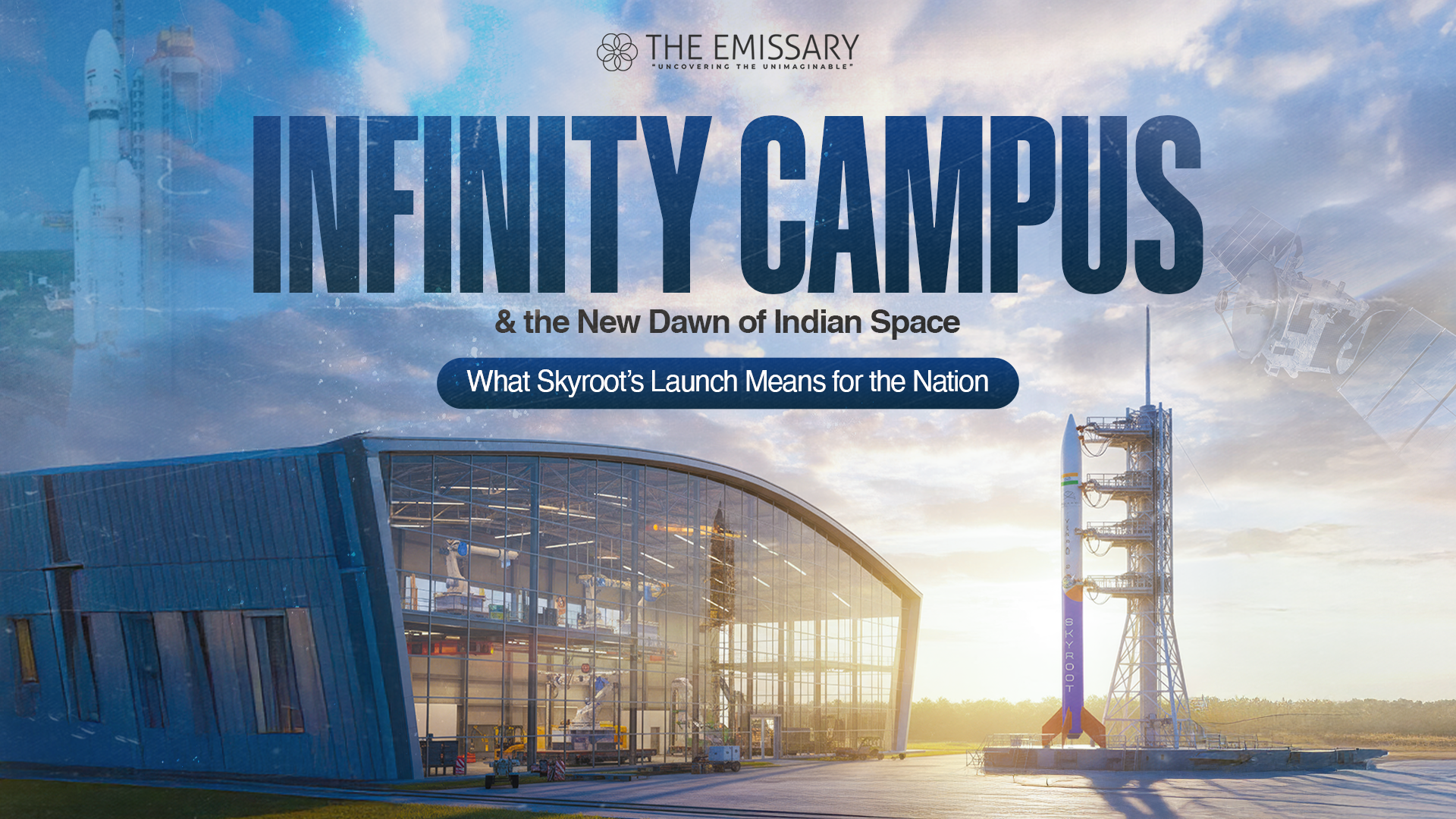
On 27 November 2025, Skyroot Aerospace added a milestone to India’s aerospace history. Via video call, Prime Minister Narendra Modi inaugurated the company’s new Infinity Campus near Hyderabad and unveiled Vikram-I, India’s first privately developed orbital launch vehicle. The facility, roughly 200,000 sq ft, is designed for end-to-end rocket design, integration and testing, with a stated ambition: produce one orbital rocket per month.
The occasion was framed as much more than a corporate blue-ribbon event, it was cast as a signal that India’s long-time monopoly in launch capacity, held by ISRO, is now giving way to a new paradigm where private firms can design, build and launch space vehicles. As Modi said, the campus “reflects India’s new thinking, innovation and, most importantly, youth power.”
From ISRO Monopoly to Private Space Ecosystem
For decades, ISRO was the single provider of launch services in India, defining launch cadence, payload limits and access to space. Private firms, if at all involved, supplied materials, sub components and support services. That reality began to shift in earnest after the 2023 reforms which opened the space sector for private participation and commercial endeavours beyond ISRO. New regulatory frameworks, especially via IN-SPACe, the Indian National Space Promotion and Authorisation Centre, paved way for private companies to design rockets, build satellites, and offer launch services.
Since then, a cluster of private companies has emerged. In addition to Skyroot, key players include Agnikul Cosmos, Bellatrix Aerospace, Dhruva Space and a handful of satellite-services firms. Collectively they are building launch vehicles, propulsion systems, satellite platforms, and ground station services.
From Suborbital to Orbital
Skyroot Aerospace was founded in July 2018 by former ISRO engineers and IIT alumni, with the aim of building small-satellite launch vehicles. In November 2022, the company achieved India’s first privately built rocket launch when its suborbital rocket Vikram-S reached outer space, a historic first. Over subsequent years, the company raised capital, scaling up infrastructure. By 2025 it had raised in excess of US$95 million. The Infinity Campus now brings design, manufacturing and testing under one roof, a step change from the fragmented supply-chain model of the past. The campus is built to produce orbital rockets at commercial scale.
Vikram-I is described as capable of carrying up to 350 kg to Low Earth Orbit (LEO) or 260 kg to Sun-Synchronous Orbit (SSO), a payload range aligned with the growing global small-satellite market. The company also says that routine assembly and launch could be compressed to 24 hours from any suitable pad.
Together, these steps reimagine what is possible in Indian space, from state-monopoly, to competitive, innovation-driven private sector participation.
What Skyroot’s Campus Signals for India’s Space Economy
Global demand for small satellite deployment, LEO constellations, Earth-observation cubesats, communication arrays, is booming. Analysts estimate India’s domestic space economy could reach US$77 billion by 2030, with launch services forming a substantial component. Until now, ISRO’s launch manifest and PSLV/SSLV schedules constrained commercial customers. Skyroot’s monthly rocket production ambition potentially offers frequent, on-demand access, critical for satellite start ups and foreign clients alike. This expands capacity, reduces backlogs and could lower launch cost premiums relative to international alternatives.
Skyroot’s rockets employ Indian-made subsystems, composite structures, solid and liquid-fuel motors, 3D-printed engines, moving India beyond reliance on imported components. As per the company’s website, all systems are “Made in India,” including carbon-composite airframes and rocket motors.
This represents a broader shift, where earlier the private sector mostly supplied parts, now it is creating an end-to-end value chain. Over time, this could create domestic expertise in rocketry, propulsion, materials engineering, forming a base for not just launch, but advanced projects including satellite constellation deployment, and reusable vehicles, etc.
As Western launch costs rise due to demand, regulation, geopolitics, affordable and reliable Indian launchers may attract global satellite operators seeking alternative launch services. Skyroot’s business-model, small-sat dedicated launches, rideshares, customised orbit insertion, is comparable to global peers like Rocket Lab or Firefly. With stable regulatory backing, Indian firms could grab a slice of the global small-sat launch market.
Rather than replacing ISRO, private firms like Skyroot, Agnikul or Bellatrix complement it. ISRO can focus on heavy-lift missions, deep-space probes and large infrastructure, while private firms handle commercial and small-sat sectors, increasing overall national capacity and innovation throughput.
Government cooperation is visible, static-test firing for Skyroot’s Kala m-1200 motor was conducted at ISRO’s test facilities at Sriharikota, indicating institutional support and shared infrastructure use.
The Wider Private Sector
Skyroot is prominent, but not alone. Agnikul Cosmos, founded 2017, based at IIT Madras, develops the small-sat rocket Agnibaan, and in 2024 carried out a suborbital test flight. Its engine, semi cryogenic and partially 3D-printed, is technologically ambitious, positioning Agnikul among India’s advanced propulsion players. Similarly, Bellatrix Aerospace works on electric-propulsion systems, offering orbit-change thrusters and satellite-services including spacecraft docking and in-space manoeuvres; its “Pushpak” orbital tug concept, for repositioning satellites or debris mitigation, signals forward-looking ambition. Another one is Dhruva Space focuses on small satellites and ground-station networks; it was among the first private firms to receive authorisation from INSPACe.
Moreover, collaborations are growing, Japan’s space-debris firm Astroscale announced in early 2025 a tie-up with Indian firms like Bellatrix and satellite-observability company Digantara Aerospace to extend orbital-servicing offerings in the Asia-Pacific, leveraging India’s growing space talent and lower cost base.
Taken together, these private entities represent a full-stack pipeline, from propulsion to launch vehicles, to satellites, ground stations and emerging services like debris management and orbital logistics.
Unlocking the Private Space Surge
Skyroot’s Infinity Campus and the private-sector surge rest on recent regulatory reforms. INSPACe, created in 2020, acts as a single-window authoriser for non-government space activities, enabling private firms to get permissions, access ISRO facilities and share infrastructure.
The November 2025 launch of Vikram-I and campus opening were described as occurring “amid unprecedented liberalisation of India’s space sector,” with reforms since 2023 allowing private participation in launch systems, satellite services, and space analytics.
This regulatory opening, coupled with funding openness and backing for start-ups, has catalysed growth. Some industry bodies now call for further support, increased budgetary allocations, support for a national satellite-connectivity mission, and easing of export/import controls.
What Must Come Next
The momentum is susceptible to persisting challenges. Producing a rocket per month is ambitious, but demands strict quality assurance, supply-chain robustness, ground-station readiness, and regulatory compliance. High cadence must not come at the cost of safety or reliability, especially as payloads increasingly include commercial satellites, foreign clients and data-sensitive customers. Moreover, Global small-sat launch capacity is expanding, from firms in the US, Europe, Japan, Japan-backed ventures and elsewhere. Indian firms must offer competitive costs, reliability, orbital precision and integrated services including launch + payload integration + ground services to differentiate. Otherwise market share may remain limited or episodic.
Scaling requires export licenses, international insurance, and orbit rights, especially if Indian launchers are to attract foreign customers. Policy clarity around export controls, including on composite materials, propulsion tech, and satellite data export, will determine international competitiveness. Sustained growth also demands trained aerospace engineers, materials specialists, payload engineers, ground-station technicians and launch operations staff. While IIT-alumni founded Skyroot, building a wide talent base, with graduates, post-grads, vocational training is essential.
Government support must move beyond gestures. Regular satellite-communications missions, Earth-observation programmes, GNSS applications and institutional procurement of launch services will anchor demand. Without pipeline ordering, private firms risk fragile business cases.
What This Represents for India’s Transformation
Skyroot’s Infinity Campus and the broader private space emergence represent a paradigm shift. From State-Led to Market-Driven Innovation, India is moving beyond the stereotype of “government-only” space activity. With private capital, risk-taking and market orientation, the sector can accelerate more dynamically than ever. Small-sat operators, universities, research institutes and young entrepreneurs may now access launch services and satellite-building, lowering barriers and encouraging innovation in Earth observation, climate data, connectivity and more.
A domestic space supply chain will generate skilled manufacturing jobs, R&D roles, and opportunities in satellite services, ground systems, data analytics, space-debris monitoring and more. As India builds independent launch capacity, it reduces reliance on foreign launch providers, enhances sovereign space access, and strengthens its position in global space diplomacy, particularly amidst rising competition in the Indo-Pacific, and growing demand for satellite-based communications, surveillance, and connectivity. High-precision composite manufacturing, propulsion systems, materials science, software-defined satellites, all spill over into defence, aerospace, telecommunications and data industries. Over time, this could drive broader industrial modernisation.
A New Chapter for Indian Space Begins
The Infinity Campus is more than a factory, it is a statement, India intends to move from a government-centric space programme to an innovation-driven, private-sector powered ecosystem.
If Skyroot delivers on its promise of regular orbital launches, and private peers like Agnikul, Bellatrix, Dhruva and others mature in tandem, India stands to emerge not just as a satellite user or payload provider, but as a competitive global launch hub.
This could transform Indian space from national agency prestige to commercial scale, global relevance, broad-based employment and technological dignity. The country’s first “SpaceX moment” may just be beginning, and the opening gambit is being played in Hyderabad.