




By Vrinda Sanghi
A thousand and seventy years before Newton, an Indian astronomer named gravity and detailed how it worked. The story of how his discovery was forgotten, attributed elsewhere, and partially recovered tells a larger story about who owns the history of science.
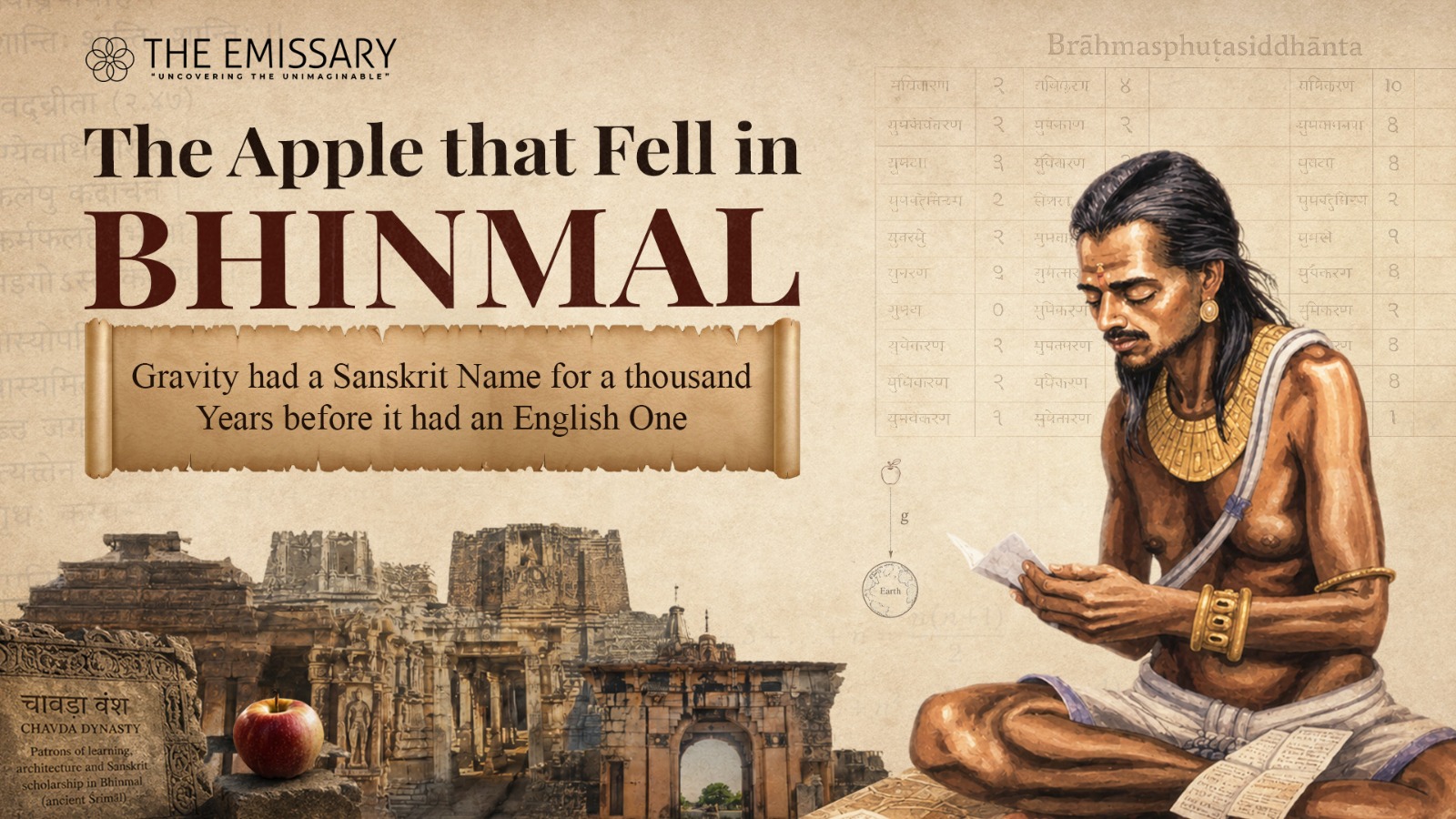
In the year 628 of the Common Era, in the desert town of Bhillamala, the modern town of Bhinmal in Rajasthan, then the capital of the Chavda dynasty, controlling over 60 ports along Gujarat and surrounding coastline, rendering it one of the most prosperous states globally, under King Vyaghramukha, a thirty-year-old astronomer completed a treatise of 1,008 verses in Sanskrit poetic metre. The work was titled Brāhmasphuṭasiddhānta, which translates as “The Correctly Established Doctrine of Brahma”. Its author was Brahmagupta (c. 598 to c. 668 CE), then director of the astronomical observatory at Bhillamala and one of the most consequential mathematical minds of the first millennium.
Embedded in the twenty-fourth chapter of this treatise, in verses that have survived in continuous Sanskrit transmission for fourteen centuries, Brahmagupta wrote what is now recognised as the first scientific statement of gravity as an attractive force. He used the Sanskrit compound gurutvākarṣaṇam (गुरुत्वाकषणर्म्), formed from three roots: guru meaning heavy or weighty, tva the abstract noun suffix indicating the quality of, and ākarṣaṇam meaning to draw or to pull. Literally, “the pulling of the heavy”. A direct English translation is “gravitational attraction”.
Brahmagupta’s accompanying explanation, preserved in the original Sanskrit and translated by multiple scholars including the eleventh-century Persian polymath Al-Biruni, runs as follows: “The earth on all its sides is the same; all people on the earth stand upright, and all heavy things fall to the earth by a law of nature, for it is the nature of the earth to attract and to keep things, as it is the nature of water to flow.” A separate verse adds: “If a thing wants to go deeper down than the earth, let it try. The earth is the only low thing, and seeds always return to it, in whatever direction you may throw them away, and never rise upwards from the earth.”
Isaac Newton, the English mathematician and natural philosopher whose Philosophiæ Naturalis Principia Mathematica set out the inverse-square law of universal gravitation, published his work in 1687. Brahmagupta preceded him by 1,059 years.
The historical context
The intellectual environment that produced Brahmagupta was the late Gupta, then arguably the most powerful world empire, and post-Gupta period, often called the classical or golden age of Indian science. By the sixth century, Indian astronomy had developed a sophisticated mathematical framework built on positional notation, decimal place values, and trigonometric functions defined through the half-chord, the jya, from which the Arabic jiba and ultimately the Latin sinus and the English “sine” are derived. The intellectual transmission network ran through observatories at Pataliputra (modern Patna), Ujjain in central India, and Bhillamala in the west.
Brahmagupta wrote in conscious dialogue with predecessors. The most important was Aryabhata (476 to 550 CE), whose Āryabhaṭīya, composed in 499 CE when its author was twenty-three, had already proposed that the Earth rotates on its axis, causing the apparent motion of stars, correctly calculated the length of the solar year to within a few minutes, and produced one of the earliest approximations of π accurate to four decimal places. Brahmagupta disagreed publicly with Aryabhata on several points, including the cause of eclipses, but inherited the mathematical apparatus. The picture in Massimo’s widely circulated social media post of an austere figure seated in robes, calculating on a slate beneath a palm tree, is iconographically composite but historically truthful in essence. Brahmagupta worked with reed pens, palm-leaf manuscripts, and an astronomical instrument tradition that included the gnomon, the armillary sphere, and water clocks.
The Brāhmasphuṭasiddhānta was a comprehensive astronomical and mathematical treatise. Its 24 chapters covered planetary motion, lunar and solar eclipses, the geometry of triangles and cyclic quadrilaterals, arithmetic operations on positive numbers, negative numbers, and zero, the first clear statement of the quadratic formula which is the algebraic solution to equations of the form ax² + bx + c = 0, and the rules now known as Brahmagupta’s identity (an algebraic identity governing the product of sums of two squares) and Brahmagupta’s theorem (a geometric result on the diagonals of cyclic quadrilaterals).
The transmission west
The Brāhmasphuṭasiddhānta did not stay in Bhillamala. In 770 CE, the Abbasid Caliph AlMansur invited an Ujjain scholar named Kanaka to Baghdad. Kanaka brought with him a copy of Brahmagupta’s work, which was translated into Arabic under the title Sindhind, a phonetic rendering of Siddhānta. The translation was supervised by Muhammad ibn Ibrahim al-Fazari, and through it Brahmagupta’s mathematics entered the Islamic intellectual world. From there, it travelled via Arabic translation into the Latin scholarship of medieval Europe through centres at Cordoba, Toledo, and Sicily.
The transmission had two distinct components, and history has remembered them very differently. The mathematical innovations of the Brāhmasphuṭasiddhānta, particularly its rules for arithmetic with zero, negative numbers, and the decimal place-value system, were absorbed into the Arabic mathematical tradition and from there into Europe, where they became the foundation of the modern numeral system, still misnamed “Arabic numerals” in most Western languages despite the Arabs themselves having called them al-arqam alHindiyyah, “the Indian numerals”.
The physical observations, including the statement on gravity, did not transmit with the same fidelity. Al-Biruni, who travelled in India in the early eleventh century and produced the most rigorous medieval European-Indian comparative scholarship, did discuss Brahmagupta’s gravitational ideas in his work Tahqiq ma li-l-Hind (“Verifying What Is Said about India”), completed around 1030 CE. But the European scientific revolution of the sixteenth and seventeenth centuries, when Galileo, Kepler, and Newton constructed modern mechanics, drew principally on Greek, Arabic, and contemporary European sources. Brahmagupta’s verses on attractive force were not part of that lineage. When Newton in 1687 wrote that “every particle of matter in the universe attracts every other particle”, he was working without knowledge of the 628 CE precedent.
The priority claim
This is the point at which careful framing matters. Brahmagupta did not state the inversesquare law. He did not provide a mathematical formula for gravitational force. He did not derive Kepler’s laws of planetary motion from a gravitational principle. What he did was identify gravity as a quality intrinsic to the Earth, the modern formulation would say “to mass”, articulate it as an attractive rather than a downward-directional force, recognise that its effect was universal across the Earth’s surface, and explain why objects on a spherical Earth all appear to fall “down,” because each falls toward the centre, regardless of where on the sphere the observer stands.
This is conceptual priority, not mathematical equivalence. Newton’s contribution was the quantitative law, which states force proportional to the product of masses, inversely proportional to the square of the distance, the unification of terrestrial and celestial mechanics under a single principle, and the calculus required to apply it. Brahmagupta’s contribution was the prior conceptual leap of treating gravity as an attractive force inherent to matter, at a time when the dominant Greek tradition, following Aristotle, treated heaviness as an intrinsic tendency of certain elements to move toward their “natural place”. The two claims are different. Both are true. The historical record has retained one and largely forgotten the other.
The Kerala school
If Brahmagupta is the most famous case of forgotten Indian scientific priority, the Kerala school of mathematics is the most consequential. Beginning with Mādhava of Sangamagrāma (c. 1340 to c. 1425 CE), a Brahmin scholar from modern-day Irinjalakuda in central Kerala, a continuous teacher-student lineage in southern India produced, between roughly 1350 and 1600, the mathematical machinery now known as the foundations of calculus. Madhava derived infinite series expansions for the trigonometric sine, cosine, and arctangent functions. These series, derived through reasoning that involved limits, infinitesimals, and term-by-term geometric arguments, are what modern mathematics calls power series. The series for the arctangent yields, as a special case at angle π/4, an infinite series for π itself: π/4 = 1 − 1/3 + 1/5 − 1/7 + 1/9 − …
In Western mathematical literature, this is the Leibniz series, attributed to Gottfried Wilhelm Leibniz, who derived it in approximately 1673. Madhava had derived it around 1400, roughly 270 years earlier. The series for sine, used by Newton in the 1660s, was derived by Madhava using methods that the Kerala school’s surviving texts (principally the Tantrasaṅgraha of Nilakantha Somayaji, completed in 1501, and the Yuktibhāṣā of Jyeṣṭhadeva, completed around 1530) preserve in detail. The Yuktibhāṣā, written in Malayalam rather than Sanskrit and containing what amount to step-by-step derivations and proofs, is now recognised by historians of mathematics as the first text in any language to present the elements of calculus systematically. It predates Newton’s De analysi by 140 years.
The Kerala school’s discoveries were brought to Western attention by Charles Whish, a junior East India Company civil servant stationed in Malabar, who published “On the Hindu Quadrature of the Circle” in the Transactions of the Royal Asiatic Society of Great Britain and Ireland in 1834. Whish’s paper was largely ignored. Serious Western academic engagement with the Kerala school began only in the mid-twentieth century, with the work of C.T. Rajagopal and M.S. Rangachari, and accelerated in 2007 when researchers at the University of Manchester and the University of Exeter, led by George Gheverghese Joseph, formally argued that the Kerala discoveries predated Newton by 250 years and had likely been transmitted to Europe through Jesuit missionaries based in Cochin in the late sixteenth century.
In recognition of priority, modern mathematical literature increasingly uses the names “Madhava-Leibniz series” for the π/4 series, “Madhava-Newton series” for the power series of sine and cosine, and “Madhava-Gregory series” for the arctangent expansion. Standard undergraduate calculus textbooks, however, still attribute these results almost exclusively to their European rediscoverers.
The broader pattern
The Brahmagupta and Madhava cases are not isolated. They fit a pattern that historians of South Asian science have documented across multiple disciplines.
In medicine, the Suśruta-saṃhitā, compiled in its surviving form around the third or fourth century CE but transmitting material from the sixth century BCE, contains detailed descriptions of surgical procedures including rhinoplasty (the reconstruction of the nose), cataract removal, the use of more than 120 surgical instruments, and the principles of antisepsis. The rhinoplasty technique known in modern surgical literature as the “Indian method” was reported by the British surgeon Joseph Constantine Carpue in 1816 after he observed it being performed by traditional surgeons in Pune; Carpue’s adoption of the technique is generally credited as the beginning of modern Western plastic surgery.
In astronomy, Aryabhata’s proposal that the Earth rotates on its axis rather than the heavens revolving around a stationary Earth was articulated more than a thousand years before Copernicus published De revolutionibus orbium coelestium in 1543. Aryabhata’s calculation of the sidereal day to 23 hours, 56 minutes, and 4.1 seconds is correct to within 0.1%.
In metallurgy, the Iron Pillar of Delhi, a 7.21-metre solid wrought-iron column erected around 400 CE at Mehrauli, has remained essentially rust-free for sixteen centuries through a corrosion-resistant phosphate-iron alloy whose chemistry was independently studied and characterised by R. Balasubramaniam at IIT Kanpur in 2002. Wootz steel, produced in southern India and exported through the port of Puhar from at least 300 BCE, was the material from which Damascus steel blades were forged in the medieval Middle East and became the technological benchmark for European steelmaking until the eighteenth century.
In linguistics, Pāṇini’s Aṣṭādhyāyī, composed around the fourth century BCE, is a complete formal grammar of Sanskrit consisting of 3,959 rules written in a meta-language of extraordinary compactness. Modern computational linguists, beginning with Noam Chomsky’s references in the 1950s and continuing through Frits Staal’s work, have repeatedly noted that Pāṇini’s grammar anticipates the formal apparatus of context-free grammar and Backus-Naur Form notation used in computer science by roughly 2,400 years.
It would be tempting to read this history as a nationalist grievance. That is not what it is, or what it should be. The actual story is more interesting and more useful. First, scientific knowledge is rarely lost; it is forgotten and rediscovered. The infinite series for π exists as a mathematical truth independent of who first wrote it down. Madhava deriving it in 1400 and Leibniz deriving it in 1673 are both real events. Neither diminishes the other.
Second, the historical record is shaped by the channels of transmission, not by the merit of the original discovery. Indian mathematics travelled to Europe through specific routes, Baghdad in the eighth century, Cochin in the sixteenth, under specific political conditions (the Abbasid Caliphate, the Portuguese maritime empire). What did and did not transmit depended on which Indian texts were translated, by whom, and under what patronage. The gaps in transmission were not gaps in Indian knowledge; they were gaps in the medieval world’s translation infrastructure.
Third, the European scientific revolution and the colonial project that accompanied it had powerful interests in presenting science as a uniquely European achievement. The Sanskrit term for this orientation, used by twentiethcentury historians of Indian science, is deśīkrtaḥ vidyā, the localisation of knowledge to one geography. The contemporary correction is not the reverse nationalism that claims everything was discovered in India first. It is the more modest recognition that the standard textbook narrative of “science begins with the Greeks and resumes with the Renaissance” is incomplete, and that filling in what is missing requires reading the original sources in their original languages, which Western academic mathematics is only now beginning to do at scale.
Fourth, and most useful for the present, this recovered history matters for the cultural confidence with which contemporary India approaches scientific frontiers. A country whose mathematical tradition derived the infinite series for π three centuries before Europe is differently positioned, intellectually, when it commits to deepwater oil exploration, to a quantum computing programme, or to a national mission on artificial intelligence. The argument is not that ancient discoveries justify contemporary ambition. It is that the historical claim that Indian science is derivative, an argument long deployed to depress Indian ambition, is empirically false. Brahmagupta named gravity in 628. Madhava derived calculus in 1400. The work in Bhinmal and Sangamagrama was the original article. The acknowledgement is overdue, and the standard against which Indian science should be measured is not the colonialera assumption of derivation, but the seven-century record that came before.